FX16 ERW Tube Mill for Φ8-25 mm Steel Tube Production
FX16 is the smallest model in the current XFX FX reference series. It is intended for buyers whose confirmed product list is concentrated on small-diameter, thin-wall round tube and compact square or rectangular tube. In this range, strip guidance, roll accuracy, controlled forming and careful finished-tube handling matter more than simply selecting a high-power line.
Round Tube Reference
Φ8-25 mm / 0.2-1.0 mm
Square Tube Reference
7×7-20×20 mm / 0.2-0.8 mm
Best-Fit Production Direction
small-diameter, thin-wall welded tube production
Engineering confirmation required: published model values are preliminary references. Final capability, configuration and production conditions follow the approved technical agreement.
Suitable Orders for FX16
- small furniture frames and lightweight welded components
- display racks, shelving members and shop-fitting tube
- greenhouse cross members and light agricultural fabrication
- small round tube where straightness and surface handling are important
Selection Boundary
A buyer should compare FX16 with FX25 when future products approach 25 mm round or 20×20 mm square, or when thicker products may be added later. The final decision must be based on the wall thickness matched to every size, not on maximum diameter alone.
For an FX16 project, separate the high-volume sizes from occasional sizes. This helps XFX review how many roll sets are needed, whether a compact accumulator is practical, and how cutting and collection should protect lighter finished tube. Buyers should also identify whether cosmetic surface condition is important for furniture or display applications.
FX16 Selection Profile: Thin-Wall Small Tube
FX16 should be evaluated as a precision small-tube line, not as a reduced version of a larger structural mill. Its strongest fit is a focused product program with repeatable small sizes and controlled wall thickness.
Best Product Mix
A concentrated list of small round, square and rectangular tubes allows tooling and operating procedures to be planned around repeat production rather than occasional oversized products.
Critical Engineering Point
For thin strip, coil condition, edge quality, strip guidance and roll finish can influence stability. Send the material grade and surface requirement before configuration.
Choose FX25 Instead When
Move the discussion to FX25 when the future product list needs more room above the FX16 reference, especially near the upper round, square or thickness limits.
When FX16 Is a Strong Fit
FX16 is most practical when recurring orders genuinely use its small-diameter, thin-wall welded tube production direction. The dominant products should fit the published reference without forcing the line to spend most of its time at an unsuitable boundary.
When to Compare Another Model
Compare ERW Tube Mill Overview when most orders sit below this range. Compare FX25 when larger or heavier products are recurring commercial requirements rather than occasional possibilities.
Main Configuration Priorities
- Controlled strip feeding for narrow and thin material
- Roll tooling designed around the buyer's most frequent small sizes
- HF welding and squeeze-roll arrangement reviewed for thin-wall products
- Cutting and run-out handling selected to limit deformation of light tube
- Electrical control, guarding and operator access planned for a compact line
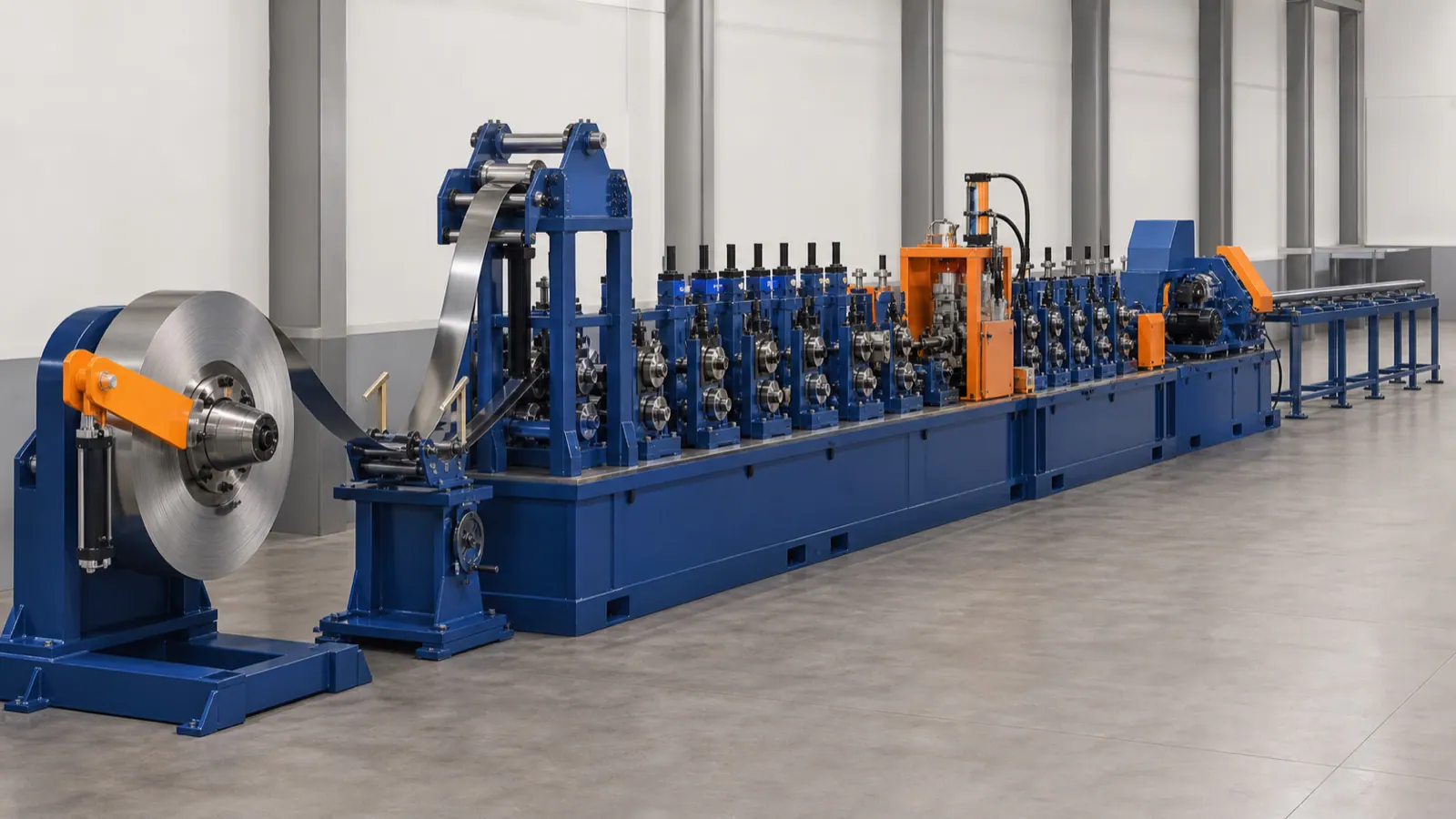
Production Process and Engineering Focus
Entry and Strip Preparation
The uncoiler and braking arrangement should feed thin strip smoothly without sudden tension changes. Narrow-strip centering is important because small lateral errors can affect forming and weld-edge position.
Accumulation and Forming
The accumulator is selected to maintain continuity while avoiding unnecessary marking of light strip. Closely controlled roll passes gradually form the small section without forcing the material too quickly.
Welding, Cooling and Sizing
Welding settings and squeeze-roll position are reviewed for the confirmed thin-wall size list. Cooling and sizing must control final dimensions without flattening or distorting light tube.
Cutting and Finished-Tube Handling
The cutting method should match tube wall, length and surface requirements for small finished products. Run-out support and collection should prevent bending, impact marks and mixed-size handling errors.
Information Needed for a FX16 Review
Product Matrix
- Every tube size and matching wall thickness
- Round, square and rectangular shapes
- Material grade and surface condition
- Finished length and cutting requirements
Factory and Project Inputs
- Recurring order priorities and future sizes
- Coil specification and strip preparation
- Voltage, workshop layout and lifting conditions
- Installation, training and spare-parts expectations
FX16 Tube Mill FAQ
Is FX16 suitable for very small thin-wall tube?
FX16 is the small-range reference in the current XFX table, but final suitability depends on the exact diameter-to-wall combination, material and tooling design. Send the complete size list for engineering review.
What is the main risk when selecting FX16?
The main risk is choosing from maximum diameter alone while ignoring thin-strip guidance, surface requirements and future sizes. A focused product list is essential for a practical configuration.
When should a buyer compare FX16 with FX25?
Compare the two models when planned products sit near the FX16 upper range or when the factory expects to add larger or thicker tube. XFX should review both the current and future product mix.
Request Your Tube Mill Solution
Send the complete size-by-thickness list for a FX16 engineering review. XFX will compare adjacent models when the order mix sits near the published reference boundary.
Official company website: View the official FX16 / FX25 model family.