Tube Mill Machine FAQ
Find practical answers about ERW tube mill machines, model selection, slitting lines, roll tooling, quotation inputs, installation preparation, and after-sales support.
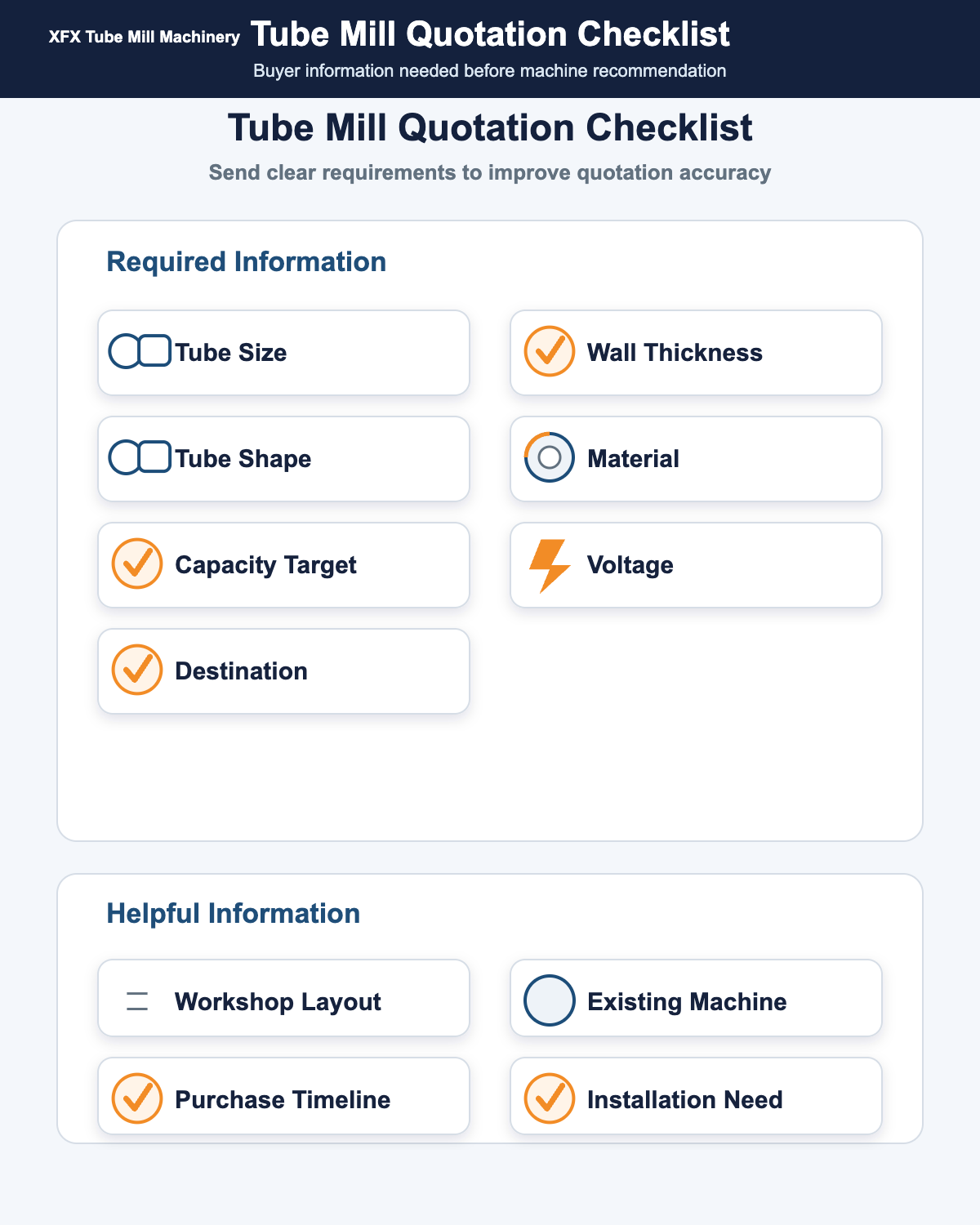
Before Asking for a Quotation
A model name or maximum tube diameter alone is not enough. Prepare the full product schedule so the machine, tooling, welding, cutting, and line-support requirements can be reviewed together.
- Tube size and wall thickness for every planned product
- Round, square, or rectangular shape
- Material grade and strip condition
- Production target and cut-length requirement
- Voltage, destination, workshop layout, and support needs
Before Quotation
What information is required for a tube mill quotation?
Send the tube size and wall thickness for each product, tube shape, material, production target, cut length, voltage, destination country, and workshop layout if available. Also explain whether you need coil preparation, packing, installation, training, or spare-parts support.
Why is wall thickness needed for every tube size?
Wall thickness affects machine loading, forming design, roll tooling, welding-system selection, cut-off method, and production stability. A wide size range can include products that need different engineering treatment, so the size-by-thickness schedule is more useful than one minimum and maximum value.
Can XFX recommend a model from only a size range?
A size range can support an initial discussion, but it is not enough for final selection. XFX also needs the matching wall thickness, material, tube shape, production plan, voltage, and workshop conditions before confirming a practical configuration.
How do I request a quotation?
Use the contact form, WhatsApp, or email to send the confirmed product list and project information. XFX reviews the technical inputs first and asks for missing details before preparing a machine proposal or quotation.
Tube Mill Model Selection
Can one tube mill produce round, square, and rectangular tubes?
Many ERW tube mill lines can form round tube and produce square or rectangular hollow sections through suitable sizing and tooling arrangements. The achievable product mix depends on the confirmed dimensions, wall thickness, material, corner requirement, and machine design.
Can one machine cover every tube size?
Not always. If the product range or wall-thickness spread is too wide, one line may create tooling, loading, changeover, and efficiency compromises. In some projects, two model ranges are more practical than forcing all products onto one machine.
What is the difference between an ERW tube mill and a high frequency welded tube mill?
ERW describes the resistance-welded tube production process and complete line context. High frequency welded tube mill is commonly used when discussing the same line type with emphasis on the high frequency welding section. XFX separates the pages so buyers can study the whole line or the welding process in more detail.
Is the maximum tube diameter enough to choose an FX model?
No. The maximum diameter must be reviewed with wall thickness, smallest planned size, tube shape, material, product mix, production target, and tooling requirement. Final model selection requires engineering confirmation.
Production Line and Equipment
What equipment is normally included in an ERW tube mill line?
A typical line may include an uncoiler, strip-end preparation equipment, accumulator, forming section, high frequency welding system, cooling, sizing section, flying cut-off, and run-out equipment. Tooling, packing, controls, and optional equipment depend on the project.
What does the high frequency welding section do?
The forming section prepares the strip edges, the high frequency system heats the edges, and squeeze rolls apply controlled pressure to form the weld seam. Cooling, seam treatment, and sizing follow according to the product and line arrangement.
How is the cut-off method selected?
The cut-off system is reviewed from tube dimensions, wall thickness, material, target length, line arrangement, expected cut quality, and production plan. A flying saw or another cut-off solution is selected only after those requirements are confirmed.
What auxiliary equipment can be added?
Options can include coil-entry equipment, accumulators, cooling systems, cut-off equipment, run-out tables, handling and packing equipment, hydraulic units, electrical controls, and selected finishing equipment. Compatibility must be checked for a new line or existing machine.
Coil Processing, Rolls, and Tooling
Do you supply slitting lines for tube mill production?
Yes. A slitting line processes a master coil into narrower strip coils for downstream tube production. Selection depends on master-coil width, thickness, weight, material, required strip widths, finished coil requirements, and production plan.
What is the difference between a slitting line and a cut to length line?
A slitting line cuts longitudinally and rewinds narrow strip coils. A cut to length line levels material and cuts across the strip direction to produce flat sheets. The required finished material determines which process is suitable.
Can XFX provide new or replacement tube mill rolls?
Yes. Roll design requires confirmed tube shapes, dimensions, wall thickness, material, machine model, stand and shaft information, roll position, and any existing drawings or production problems. Tooling compatibility should never be guessed.
Which steel materials can be discussed for a carbon-steel tube mill?
Projects may involve HR, CR, GI, PPGI, or related steel-strip materials, subject to confirmed grade, mechanical properties, surface condition, and welding suitability. The material must be reviewed with the product and machine configuration.
Installation, Quality Control, and After-Sales Support
Does XFX provide overseas installation guidance?
Installation and commissioning support can be arranged according to the project, destination, travel conditions, and agreed commercial scope. Buyer preparation, foundation, utilities, lifting equipment, local labor, accommodation, and timing should be confirmed before dispatch.
What support is available if we do not have experienced technicians?
XFX can discuss manuals, drawings, remote communication, operator guidance, troubleshooting, spare-parts coordination, and on-site support where agreed. The exact service scope and responsibilities are confirmed before order or shipment.
What operator training can be provided?
Training can cover the agreed equipment, start-up checks, adjustment principles, routine operation, maintenance points, tooling handling, and basic fault communication. Training scope, location, language, and prerequisites are project-specific. For coil-processing teams, review the slitting line operator training checklist.
What quality checks are completed before shipment?
Checks can include incoming material or machined-part inspection, welding and assembly checks, alignment, electrical inspection, no-load testing, running trial under suitable conditions, photo or video confirmation, and packing inspection. The exact acceptance scope is agreed for each project.
Customization and Project Boundaries
Can a tube mill line be customized?
Yes. The line can be discussed around the confirmed product range, wall thickness, material, production plan, workshop space, voltage, operation method, component preferences, and support needs. Customization does not replace engineering confirmation.
Can XFX guarantee a production speed or capacity from a model name?
No single model name guarantees a production result. Actual output depends on the product schedule, material, welding, tooling, cut length, operator practice, line configuration, and site conditions. Any performance target must be reviewed and documented for the specific project.
How long does machine production take?
The schedule depends on machine model, line configuration, tooling quantity, purchased components, inspection requirements, order sequence, and documentation. A project schedule can be discussed after technical and commercial details are confirmed.
Does XFX produce stainless steel TIG or laser tube mills?
XFX primarily focuses on carbon-steel high frequency welded tube mill machines for suitable steel-strip materials. If your project requires stainless-steel TIG or laser welding, confirm the process with XFX before assuming the equipment is within scope.
Related Buyer Resources
Continue with product selection, model comparison, project planning, or a direct technical inquiry.
ERW Tube Mill Machine
Understand the complete line process, model boundary, tooling, and quotation inputs.
View ERW Tube MillsProducts
Compare tube mills, coil-processing equipment, roll tooling, and auxiliary systems.
Browse ProductsKnowledge Center
Use buyer guides, model selection, process, installation, and maintenance resources.
Open Knowledge CenterProject Planning
Review the information path from requirement confirmation to installation support.
Open Project CenterRequest Your Tube Mill Solution
Send your tube size list, wall thickness for each size, tube shape, material, production target, voltage, destination country, and workshop layout if available. XFX will review the information before discussing the line configuration.
Service scope is confirmed for each project. XFX can support installation guidance, operator training, remote technical communication, trial running under suitable conditions, pre-shipment checks, and spare-parts coordination. On-site support, buyer preparation, test scope, timing, and commercial responsibilities are agreed before order or shipment.