How to Choose an ERW Tube Mill Model
Selecting an ERW tube mill requires more than checking the maximum pipe diameter. Tube shape, exact size, matching wall thickness, material, production target, tooling, welding power and cutting method must be reviewed together.
Start with the Products You Need to Make
A broad request such as “20-80 mm tubes with 0.8-3.0 mm wall thickness” is useful for an initial discussion, but it does not show which wall thickness belongs to each tube size. The same outside diameter can require a different machine configuration when material strength, wall thickness, tube shape or cutting requirement changes.
Tube shape and size
List every important round, square and rectangular product with its exact outside dimensions.
Matching wall thickness
Attach the required wall thickness to each size instead of giving one unrelated minimum and maximum.
Material and output
State the steel grade or strip type, main production sizes and realistic capacity or speed target.
XFX ERW Tube Mill Model Reference
The following values were recovered from XFX’s published model reference table. They can help narrow the initial model family, but they are not an unconditional production guarantee or final quotation.
Mobile: swipe the table left or right to view all columns.
| Model | Round OD (mm) | Round wall (mm) | Square size (mm) | Square wall (mm) | Main motor (kW) | HF welder (kW) | Speed (m/min) |
|---|---|---|---|---|---|---|---|
| FX16 | Φ8-25 | 0.2-1.0 | 7×7-20×20 | 0.2-0.8 | 22/30 | 100 | 40-120 |
| FX25 | Φ8-32 | 0.3-1.5 | 7×7-25×25 | 0.3-1.2 | 37/45 | 100 | 40-120 |
| FX28 | Φ10-38 | 0.4-1.8 | 8×8-30×30 | 0.4-1.5 | 55/75 | 100 | 30-110 |
| FX32 | Φ12-50 | 0.5-2.2 | 10×10-40×40 | 0.5-1.8 | 90/110 | 150 | 30-110 |
| FX45 | Φ16-63 | 0.6-2.5 | 12×12-50×50 | 0.6-2.0 | 132/160 | 150 | 30-100 |
| FX50 | Φ19-76 | 0.7-3.0 | 15×15-60×60 | 0.7-2.5 | 160/185 | 200 | 30-90 |
| FX60 | Φ25-89 | 0.8-3.5 | 20×20-70×70 | 0.8-3.0 | 160/185 | 250 | 30-90 |
| FX76 | Φ38-102 | 1.0-4.0 | 30×30-80×80 | 1.0-3.2 | 200/110×2 | 300 | 20-80 |
| FX89 | Φ50-127 | 1.2-4.5 | 40×40-100×100 | 1.2-3.5 | 250/132×2 | 400 | 20-70 |
| FX114 | Φ63-152 | 1.5-5.0 | 50×50-120×120 | 1.5-4.0 | 160×2 | 400 | 15-60 |
| FX165 | Φ89-203 | 2.0-6.0 | 70×70-150×150 | 2.0-5.0 | 200×2 | 500 | 15-50 |
| FX219 | Φ102-229 | 3.0-8.0 | 80×80-180×180 | 3.0-6.0 | 250×2 | 600 | 10-40 |
| FX273 | Φ127-254 | 4.0-10.0 | 100×100-200×200 | 4.0-8.0 | 132×2+160×2 | 800 | 10-30 |
Six Checks Before Choosing a Model
1. Check the heaviest product
Review the largest size together with its wall thickness and material, not as separate maximum values.
2. Identify main production sizes
A model should support the products you will run most often, not only an occasional extreme size.
3. Confirm tube shapes
Square and rectangular products affect sizing design, roll tooling and the practical model range.
4. Review welding demand
Material, wall thickness and speed influence the suitable HF welding configuration.
5. Select cutting quality
Hot friction saw, cold saw and other solutions have different tube-end, speed and budget considerations.
6. Plan the whole line
Coil handling, accumulator, run-out, packing, workshop space and local power conditions affect the final project.
Why Overlapping Model Ranges Need Review
FX45 and FX50, or FX60 and FX76, may cover some of the same diameters. This does not mean the models are interchangeable. A project concentrated near the upper wall-thickness or diameter limit may require a different machine structure, drive, welding or cutting arrangement than a project producing mostly light-wall tubes.
The practical choice balances current products, future product plans, production stability, tooling scope, investment and workshop conditions. XFX should review the complete specification before recommending one model.
Information to send
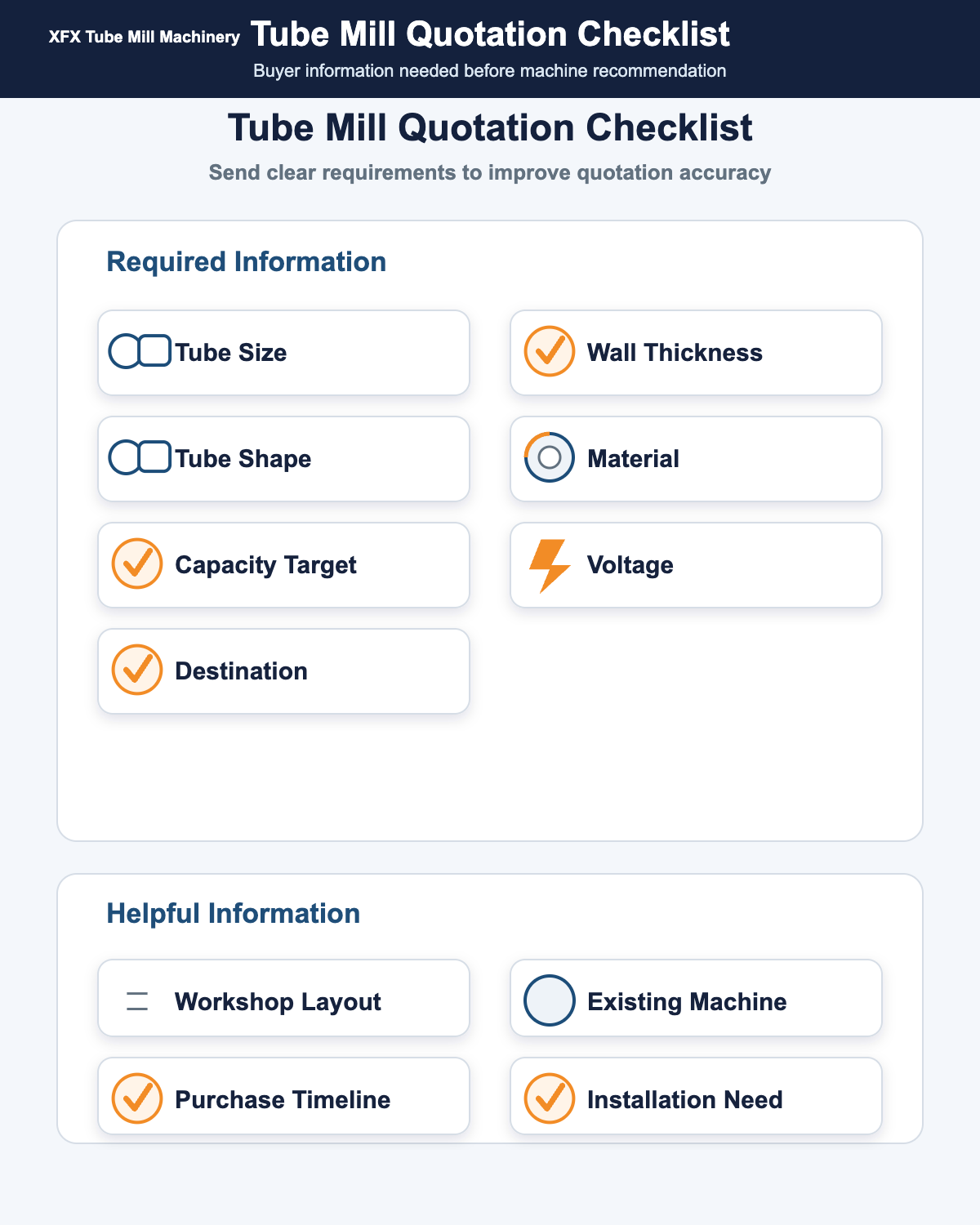
- Tube shape and exact dimensions
- Wall thickness for every important size
- Material grade or strip type
- Main products and future sizes
- Capacity or speed target
- Factory voltage and frequency
- Workshop layout if available
- Destination country and installation needs
A Four-Step ERW Tube Mill Shortlisting Method
Use this sequence before comparing prices. It turns a broad model question into a specification that an engineer can review.
1. Build the product schedule
List every round, square and rectangular tube with its matching wall thickness. Mark the main products and the products planned for future expansion.
2. Find the demanding combinations
Identify the largest diameter, thickest wall and largest square section as separate cases. They may not occur on the same product.
3. Confirm the process requirements
Record material grade, strip condition, weld-seam treatment, cutting length, end quality and any finishing equipment needed after the mill.
4. Check the factory conditions
Confirm voltage, frequency, available floor space, crane or coil-handling conditions, operator experience and installation-support requirements.
Common Model-Selection Mistakes to Avoid
Choosing only by maximum diameter
A diameter can appear in two model ranges, but different wall thicknesses and materials create different forming, welding and cutting demands.
Sending one wall thickness for the whole range
Assign the required wall thickness to each important size. This prevents an apparently suitable model from failing the most demanding products.
Ignoring square and rectangular products
Round-to-square requirements affect sizing, tooling and the practical model choice. State the exact square and rectangular dimensions.
Comparing price before configuration
Two quotations can include different welding power, cutting methods, roll quantities and auxiliary equipment. Compare confirmed scope, not the model name alone.
Use the model pages for a first reference
Review the linked FX model pages in the technical table above, then compare adjacent model families below. Send the final product schedule through the tube mill inquiry form for engineering review.
Compare XFX Model Families
Tube Mill Model Selection FAQ
Can one tube mill cover every size from FX16 to FX273?
No. Each line has a practical production range. A very wide product range may require more than one line or a project-specific solution.
Is a larger model always a better choice?
No. A larger model may increase investment and may not be the most efficient choice for small light-wall products. The main production list should guide selection.
Are the reference speeds guaranteed?
No. They are reference values from XFX’s published model table. Actual speed depends on size, wall thickness, material, welding, cutting, tooling and line configuration.
Can the models produce rectangular tubes?
Rectangular production can be discussed, but the published reference table lists round and square references only. Send exact rectangular sizes and wall thicknesses for engineering review.
What is the fastest way to receive a useful recommendation?
Send a product list showing tube shape, exact dimensions and wall thickness for each size, plus material, output target, voltage, country and workshop layout if available.
Request Your Tube Mill Solution
Send your tube size list, wall thickness, material, capacity target, destination country, and factory voltage. XFX will review your requirements before recommending a practical machine configuration.
Official company website: Read the official FX model selection guide.