ERW Tube Mill Production Process: From Steel Coil to Finished Pipe
The ERW tube mill production process uses a continuous production line to convert steel strip into welded steel pipe through coil preparation, forming, high frequency welding, cooling, sizing and cutting.
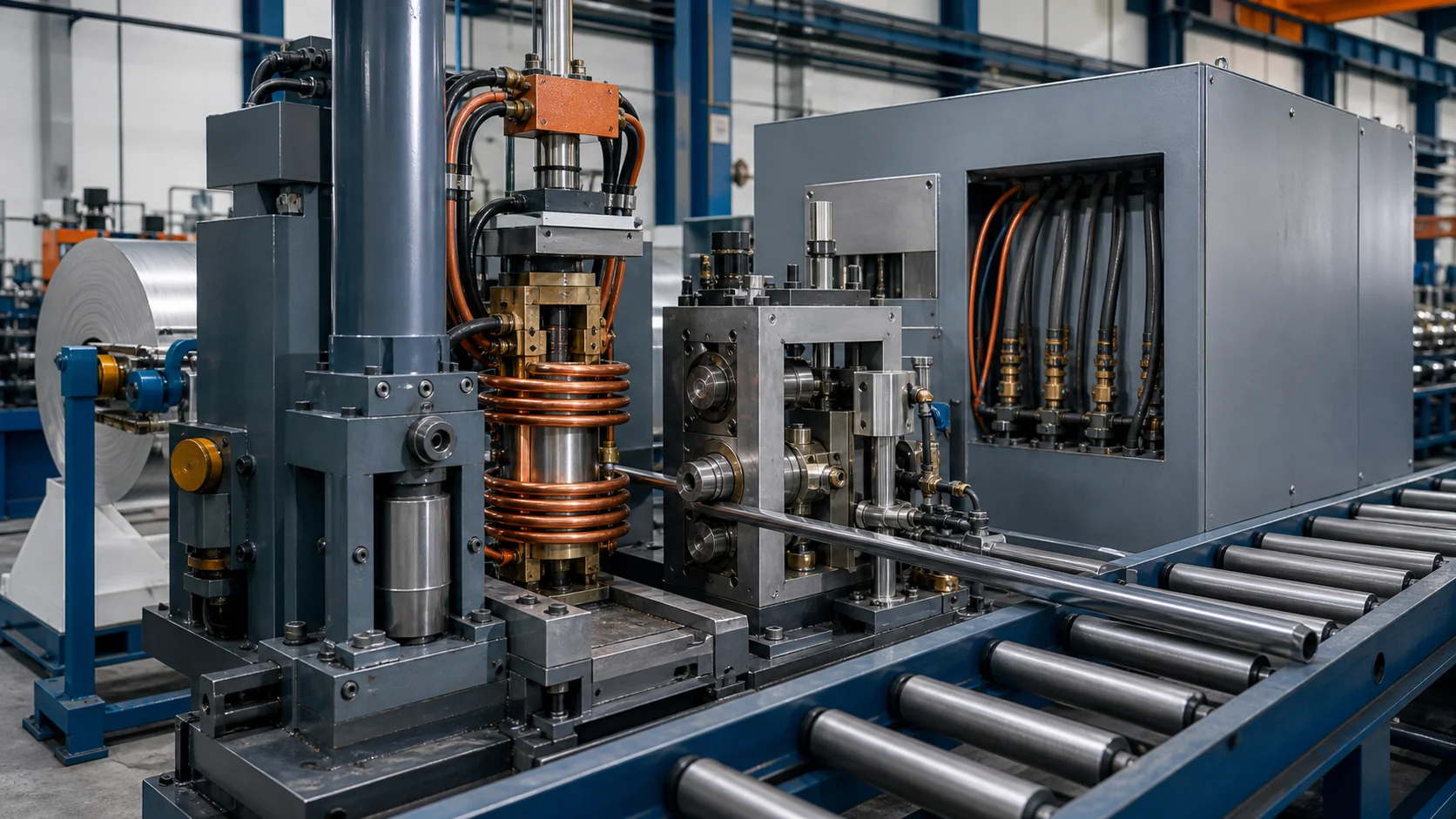
Overview of the ERW Tube Mill Process
An ERW tube mill production line turns steel strip into welded steel pipe through a continuous process. The main sections normally include uncoiler, strip preparation, accumulator, forming section, high frequency welding, cooling, sizing, flying saw and run-out table. The exact configuration depends on tube size, wall thickness, material and production plan.
Understanding this process helps buyers send better inquiry information. It also helps factory owners compare suppliers more clearly, because each section affects production stability and finished tube quality.
1. Uncoiling and Strip Preparation
The steel coil is loaded onto the uncoiler, and the strip is fed into the tube mill line. Depending on the line configuration, a shear and joining arrangement may help connect strip ends during coil change preparation. Stable feeding is important because poor strip preparation can create problems later in forming and welding.
2. Accumulation
An accumulator stores steel strip so the line can continue running while a new coil is prepared. The accumulator style and capacity should match strip width, wall thickness, production speed and available workshop space. Buyers should discuss layout early if workshop length is limited.
3. Forming Section
The forming section gradually bends flat steel strip into an open tube shape. Roll tooling design is important because the strip edges must approach the welding point in the correct position. If forming is unstable, welding adjustment becomes more difficult and finished tube quality may be affected.
Buyers who need multiple tube sizes should also discuss tooling plan and size change arrangement. More tube sizes usually mean more roll sets and more production planning.
4. High Frequency Welding
The prepared strip edges are heated and joined by the high frequency welding system. Welding stability depends on forming accuracy, edge condition, welding power, squeeze roll pressure, material and operator adjustment. See the High Frequency Welded Tube Mill page for more detail about this section.
5. Cooling, Sizing and Cutting
After welding, the tube is cooled and passes through sizing sections to control final dimensions. The flying saw cuts the tube to length while the line continues running. Downstream run-out and collection equipment should be planned according to tube length, factory space and packing method.
How Buyers Should Use This Information
If your product range is still unclear, compare FX28, FX45 and FX60 model pages before requesting a quotation. If your project includes strip preparation, also review the Slitting Line page. For tooling questions, review Tube Mill Rolls.
The final line should be reviewed according to real product requirements. Send tube size, wall thickness, material, capacity target, voltage and destination country through the Contact page.
Why Process Understanding Helps Quotation
When buyers understand the ERW tube mill process, they can describe requirements more accurately. For example, if a buyer knows that forming affects welding, they will understand why roll tooling and strip quality matter. If a buyer knows that cutting happens while the line keeps running, they will understand why flying saw configuration should match tube size and speed.
This process knowledge also helps buyers judge whether a quotation is complete. A tube mill line without a suitable accumulator, welding system, sizing arrangement or run-out plan may not support the expected production flow. Every section should be reviewed as part of one complete line.
Common Process Problems to Avoid
Unstable strip feeding can create forming variation. Poor forming can make the strip edges difficult to weld. Incorrect welding setup can affect seam quality. Weak cooling and sizing control can make final dimensions unstable. A cutting system that does not match the line can reduce efficiency. These problems are not solved by one component alone; they require proper line configuration and operator adjustment.
Before purchase, ask the supplier to explain how the proposed process matches your tube range. If your plan includes square and rectangular tubes, ask how the round-to-square sizing will be handled. If your factory uses galvanized strip, discuss material condition and welding considerations. If your target tube length is fixed, discuss cutting accuracy and downstream collection.
The ERW tube mill process should be treated as a system. XFX reviews forming, welding, sizing, cutting, layout and support together before confirming the final proposal.
Line Configuration Should Follow the Process
Each section of the ERW tube mill affects the next section. The uncoiler and accumulator affect feeding stability. Forming affects edge position. Welding affects seam quality. Sizing affects final dimensions. Cutting affects downstream handling. When buyers send complete production information, the supplier can review these sections together and avoid a weak point in the line.
Send Your Tube Size
Send your tube size, wall thickness, material, capacity target and destination country. XFX will review the information and recommend a practical tube mill solution before quotation.
Send InquiryWhatsApp Now