How to Choose an ERW Tube Mill Machine
A practical buyer guide for selecting an ERW tube mill machine by tube size, wall thickness, tube shape, material, production target, factory layout, and support requirements.
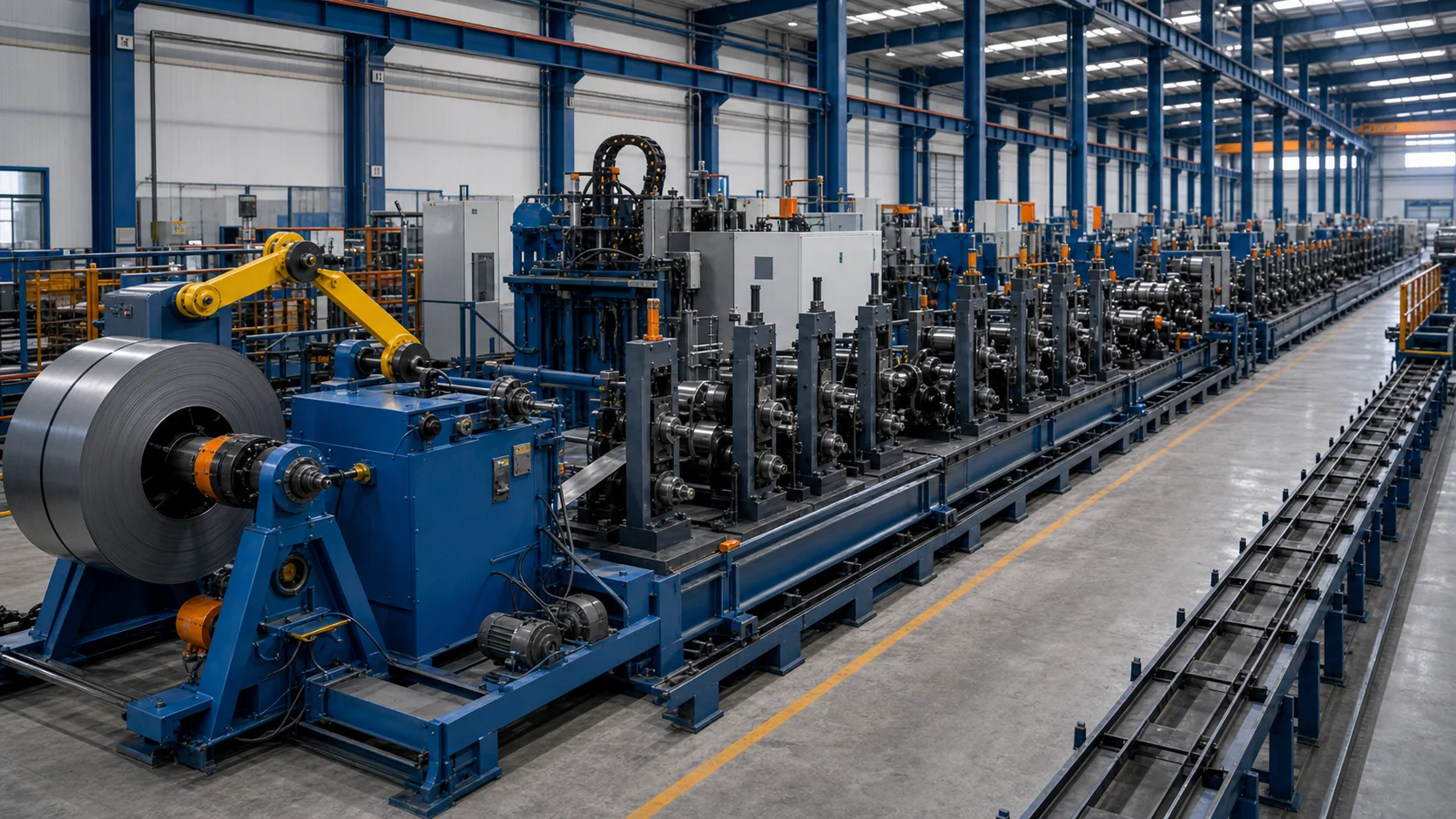
Quick Answer
To choose the right ERW tube mill machine, prepare the exact tube sizes, matching wall thickness for each size, required tube shape, material type, production target, factory voltage, and workshop layout. A tube mill manufacturer can then review the forming section, high frequency welding system, sizing section, flying saw, roll tooling, and auxiliary equipment as one complete production line.
Key Factors Before Choosing a Tube Mill
Tube Size Range
List the exact round, square, and rectangular tubes you plan to produce. Separate main production sizes from occasional sizes.
Wall Thickness by Size
Match every tube size with its wall thickness. This affects forming load, welding demand, roll tooling, and cutting selection.
Tube Shape
Round tube, square tube, and rectangular tube requirements affect sizing design and roll tooling arrangement.
Material Type
HR, CR, GI, and other steel strip materials should be confirmed before final model and welding configuration are selected.
Production Target
Output target, main sizes, shift plan, and cutting requirement help determine whether the line configuration is practical.
Factory Conditions
Voltage, workshop length, line direction, crane condition, and installation support needs should be reviewed early.
Published Reference XFX FX Model Reference
The model ranges below are XFX published technical reference data for initial discussion. They help narrow the model direction, but final machine capability, configuration, roll tooling, speed, motor, welder, and contract scope must be confirmed by engineering review.
| Model | Round OD Reference | Round Wall Reference | Square Tube Reference | Common Selection Direction |
|---|---|---|---|---|
| FX16 | Φ8-25 mm | 0.2-1.0 mm | 7×7-20×20 mm | Small welded tube production and light tube ranges. |
| FX25 | Φ8-32 mm | 0.3-1.5 mm | 7×7-25×25 mm | Small to medium small tube production. |
| FX28 | Φ10-38 mm | 0.4-1.8 mm | 8×8-30×30 mm | Common small tube and light structural tube projects. |
| FX32 | Φ12-50 mm | 0.5-2.2 mm | 10×10-40×40 mm | Small and medium welded tube ranges. |
| FX45 | Φ16-63 mm | 0.6-2.5 mm | 12×12-50×50 mm | General structural pipe and medium tube production. |
| FX60 | Φ25-89 mm | 0.8-3.5 mm | 20×20-70×70 mm | Medium tube and thicker structural tube ranges. |
| FX76 | Φ38-102 mm | 1.0-4.0 mm | 30×30-80×80 mm | Medium-large tube production projects. |
| FX89 | Φ50-127 mm | 1.2-4.5 mm | 40×40-100×100 mm | Large structural tube and pipe production direction. |
| FX114 | Φ63-152 mm | 1.5-5.0 mm | 50×50-120×120 mm | Larger welded pipe and structural tube projects. |
Understand the ERW Tube Mill Process
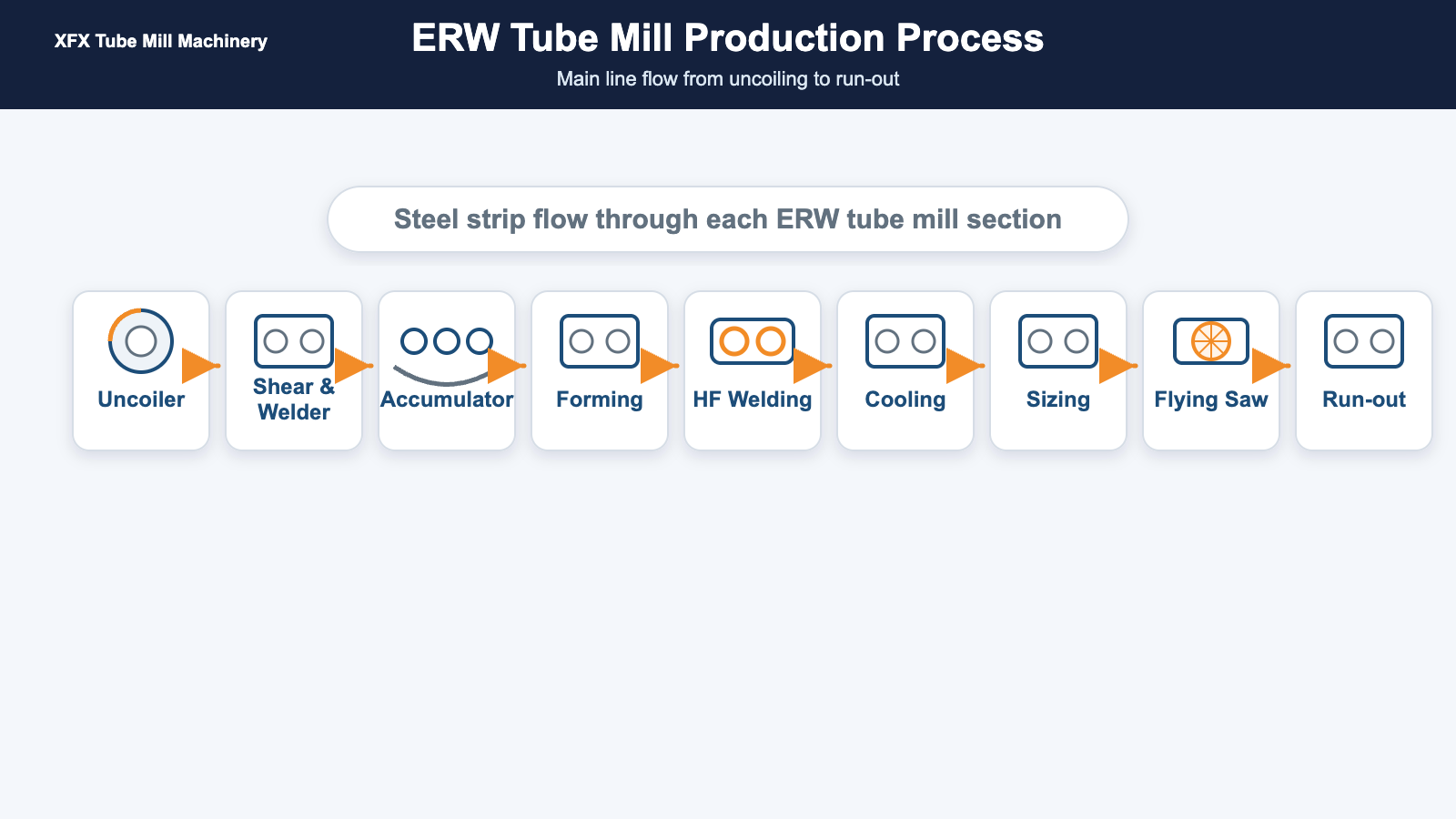
An ERW tube mill line normally includes uncoiling, strip joining, accumulator, forming, high frequency welding, cooling, sizing, flying saw cutting, and run-out. Each section must match the product range and production plan.
- Forming section: gradually bends flat strip into an open tube shape.
- HF welding section: heats strip edges before they are pressed together.
- Sizing section: controls final tube dimensions and round, square, or rectangular shape.
- Flying saw: cuts the welded tube according to required length and line speed.
Information to Send Before Quotation
A clear inquiry reduces repeated questions and helps the manufacturer prepare a practical tube mill solution faster.
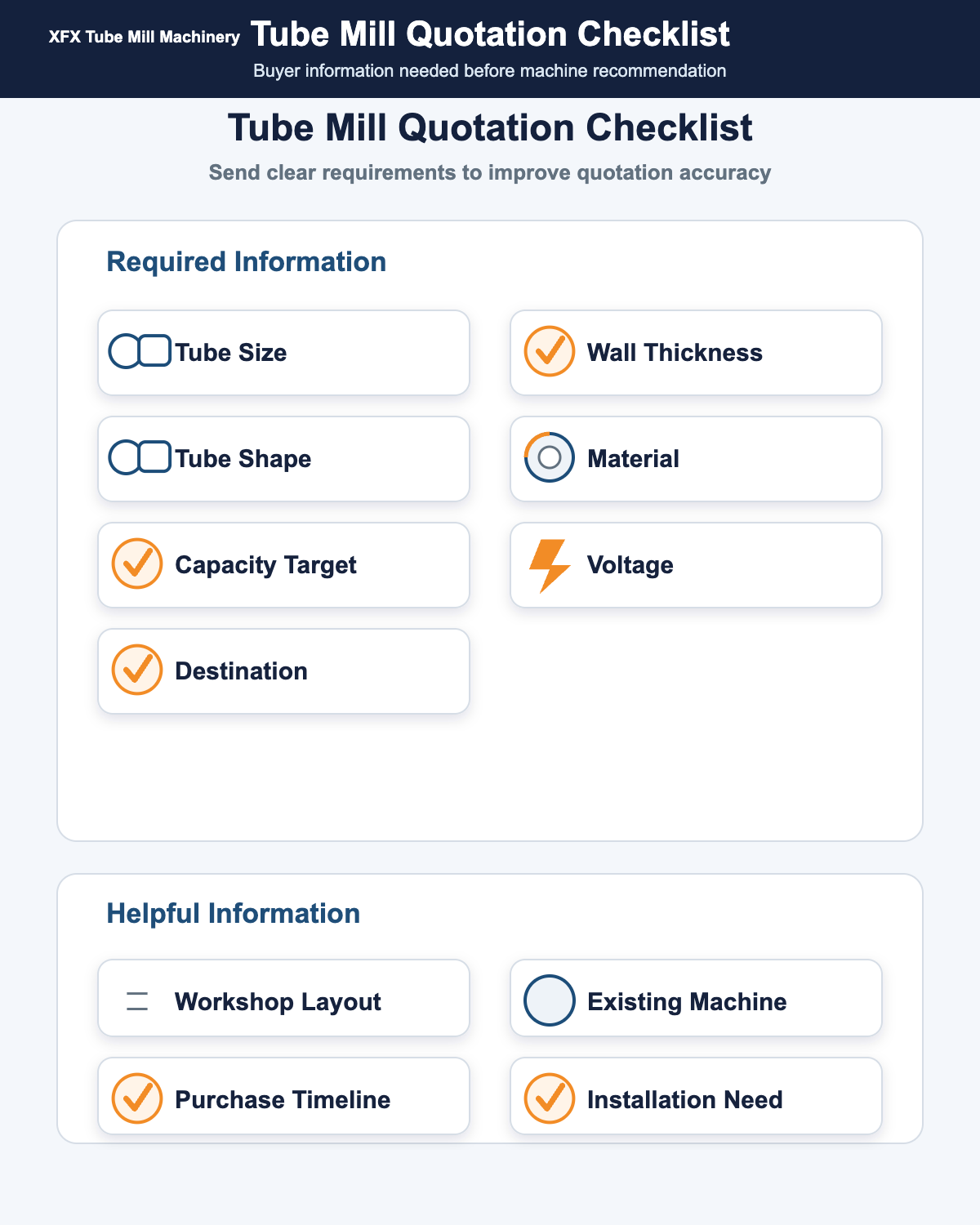
Required Product Data
- Tube sizes
- Wall thickness for each size
- Round, square, or rectangular tube shape
- Material type
Factory and Operation Data
- Voltage and frequency
- Available workshop layout
- Production capacity target
- Destination country
Project Support Needs
- Installation support
- Operator training
- Spare parts plan
- Existing slitting or auxiliary equipment
How to Evaluate a Tube Mill Supplier
After narrowing the model range, compare suppliers by technical communication and confirmed scope, not only by price. A responsible supplier should ask detailed questions because the correct tube mill depends on the buyer’s real production plan.
Technical Review Before Quotation
- Ask how wall thickness is matched to every tube size and shape.
- Confirm how roll tooling, welding, cutting, and line configuration are reviewed.
- Check whether the supplier explains the practical difference between small, medium, and larger model ranges.
Complete Scope and Support
- Confirm whether rolls, slitting, auxiliary equipment, and workshop layout are included in the discussion.
- Clarify installation guidance, operator training, remote troubleshooting, and spare-parts support.
- Ask the supplier to state what is included, excluded, and still subject to engineering confirmation.
Model pages are useful for orientation, but they do not replace engineering review of the complete size-by-thickness schedule and factory conditions.
Common Selection Mistakes
Many quotation delays come from incomplete or unclear technical information. Avoid these mistakes before choosing an ERW tube mill machine.
- Only sending the maximum pipe diameter without wall thickness.
- Combining all tube sizes and all thicknesses into one unclear range.
- Ignoring square and rectangular tube requirements.
- Choosing a model without checking material and welding demand.
- Forgetting workshop layout, voltage, installation, and spare parts support.
Recommended Next Step
Prepare a simple list with tube size, wall thickness, material, tube shape, and destination country. Then send it to XFX for engineering review before comparing final price.
Related Resources
ERW Tube Mill Buyer FAQ
How do I choose the right ERW tube mill machine?
Start with exact tube sizes, matching wall thickness for each size, tube shape, material, production target, voltage, and workshop layout. XFX can then review a suitable model and line configuration.
Can one ERW tube mill make round, square, and rectangular tubes?
Many ERW lines can produce round tubes and then form square or rectangular tubes through the sizing section and suitable roll tooling. The final range depends on model, wall thickness, material, and tooling design.
Why is wall thickness important for model selection?
Wall thickness affects forming load, roll design, welding demand, cutting method, motor selection, and production stability. It should be matched with each tube size before quotation.
Do I need a slitting line with an ERW tube mill?
If steel strip preparation is not available locally or you want to process coils in-house, a slitting line may be needed. Coil width, coil thickness, strip width, and output target should be reviewed.
Does XFX provide installation support?
XFX can provide installation guidance, operator training, remote support, and spare parts support according to project requirements and destination conditions.
Request Your Tube Mill Solution
Send your tube size list, wall thickness, material, capacity target, destination country, and factory voltage. XFX will review your requirements before recommending a practical ERW tube mill machine configuration.
Official company website: Read the official tube mill model selection guide.